China+1 vs China Sourcing: What Importers Should Really Know
 Hidayat Khan·May 2026·10 min read
"Should I move my production out of China?" is one of the most common questions importers ask us right now. The honest answer is rarely a clean yes or no. This article cuts through the China+1 hype: what the strategy actually means, why brands are looking at Vietnam, India and Thailand, where China still wins, and how to compare your options on the numbers that matter rather than the headlines.
What China+1 actually means
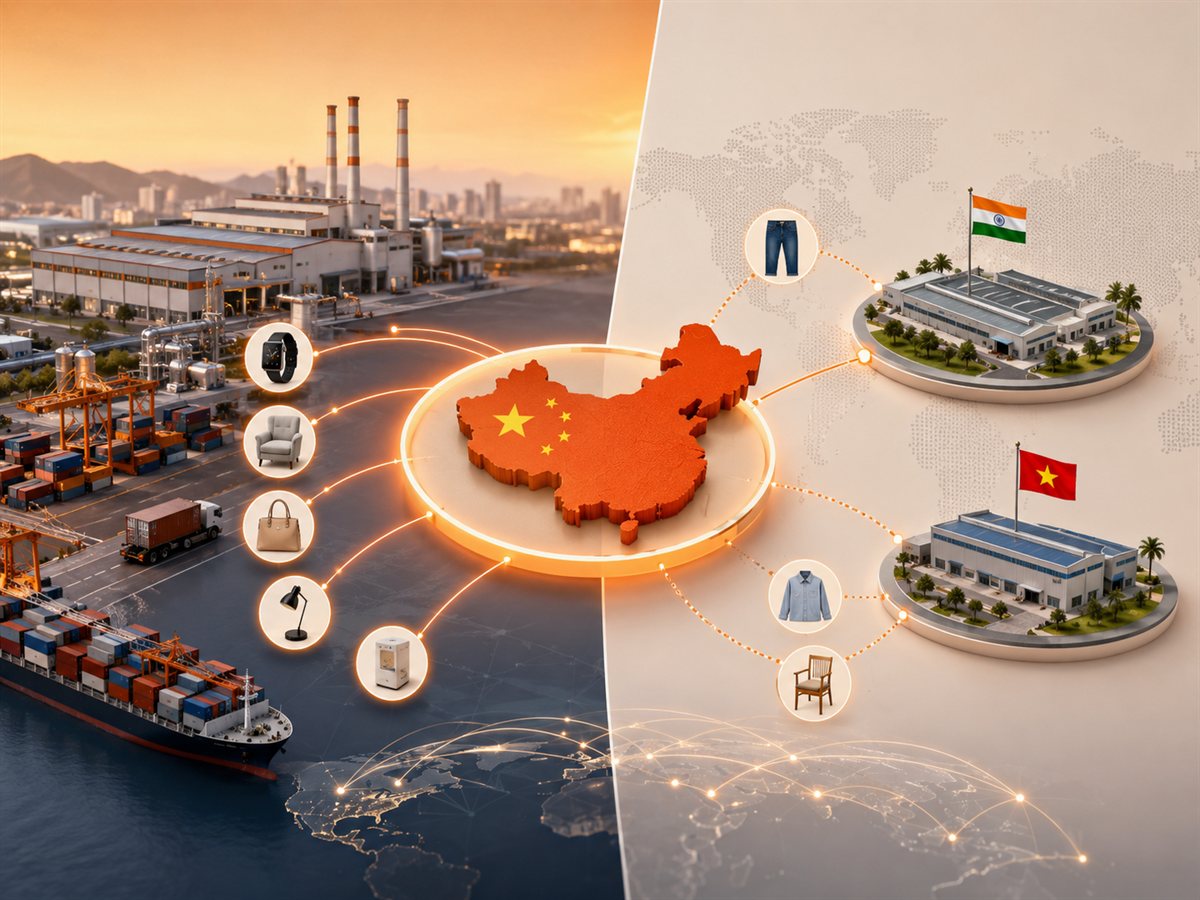
China+1 is a sourcing strategy, not an exit plan. The idea is simple: keep your core production in China, where it usually makes the most sense, and add at least one alternative country as a backup or a partial second source. The "1" might be Vietnam, India, Thailand, Mexico, or even a domestic supplier closer to your market. The point is that you stop relying on a single country for a critical product.
Most importers misread the term as "move everything out of China." That is not what serious operators do. China+1 is about reducing concentration risk, not abandoning a supply chain that took years to build. You're buying optionality, the ability to shift volume if tariffs spike, a port closes, or a single factory has a bad quarter.
Done well, China+1 looks boring from the outside: the same products shipping on the same schedule, with a second qualified factory in another country quietly ready to take on 20 to 40 percent of volume if needed. That redundancy is the whole value.
Why brands are exploring Vietnam, India, Thailand and others
The push toward alternative countries comes from real pressures, not just trend-chasing. Tariffs and trade tension have made some buyers nervous about routing everything through one origin. Rising labour costs in China's coastal hubs have narrowed the price gap for simpler products. And after a few years of disrupted freight and unpredictable shutdowns, plenty of brands simply want a plan B they can point to when their board asks about supply risk.
Each alternative country has a sweet spot. Vietnam has become strong in apparel, footwear, furniture and basic electronics assembly. India is competitive in textiles, leather goods, pharmaceuticals and certain metal products, with a huge domestic workforce. Thailand does well in automotive parts, electronics and food processing. None of them replicates China across the board, they each cover a slice.
- Tariff and trade-policy exposure on China-origin goods
- Lower labour costs for simple, labour-heavy products
- Customer or retailer requirements for diversified sourcing
- Genuine supply-risk reduction after recent disruptions
- A second origin to use as negotiating leverage with Chinese suppliers
China+1 isn't about leaving China. It's about not being trapped if you ever need to.
China's advantages: supplier ecosystem, components, packaging and speed
Before you move anything, it's worth being clear-eyed about why China became the default in the first place. It isn't just cheap labour, that advantage has been shrinking for a decade. The real moat is the ecosystem. In a single industrial cluster around Guangzhou, Shenzhen or Yiwu, you can find the factory, the component suppliers, the mould makers, the packaging printers and the freight forwarders within an hour of each other.
That density is what makes China fast. Need a custom box, a new colourway, or a tweaked component? In many Chinese clusters that's a few days, because everything you need is next door. In a newer manufacturing country, the same change can mean importing components from China anyway, waiting on tooling, and adding weeks to your timeline. A surprising amount of "Vietnamese" or "Indian" production still depends on Chinese raw materials and parts.
For anything with multiple components, custom packaging, frequent design iterations, or tight launch windows, China's supply ecosystem remains hard to beat. The further your product moves from a simple, single-material item, the more that ecosystem matters.
- Dense clusters where factories, parts and packaging sit side by side
- Mature mould-making and tooling for fast design changes
- Deep, experienced freight and export infrastructure
- Speed on samples, revisions and reorders that newer hubs rarely match
Risks of moving production too early
The most expensive mistake we see is brands chasing a lower headline price into a new country before that country is actually ready for their product. A quote that looks 10 percent cheaper can quietly cost you far more once you add tooling you have to rebuild, components shipped in from China, longer lead times, a steeper learning curve on quality, and a supplier who has never made your exact product.
New manufacturing bases also have thinner factory pools. In China you can shortlist five qualified factories for a niche product in a week; in a younger market you might find one or two, which kills your leverage and leaves you exposed if that single supplier underperforms. Quality systems, English-language communication, and export documentation are often less developed too, all things that cost time and money to manage.
Moving too early tends to mean paying to discover problems that China solved years ago. The smarter sequence is to qualify the alternative slowly and in parallel, while your proven China supply keeps the business running.
Best strategy: China for development, China+1 for backup
For most importers, the strongest setup is to use China as your development and primary production base, and treat the +1 country as a secondary, qualified source you build up over time. China is where you iterate on the product, dial in the tooling, perfect the packaging and run your main volume. The second country is where you place a smaller, ongoing order so the relationship and the quality are already proven before you ever need to lean on it.
The mistake is treating the +1 supplier as theoretical, a name in a spreadsheet you've never actually ordered from. A backup you've never tested is not a backup. Run real production through it, even at low volume, so that if you ever need to shift, you're scaling an existing relationship rather than starting cold under pressure.
Develop in China where speed and the ecosystem pay off, then deliberately build a live second source for the products where concentration risk genuinely worries you. This is the work we do for clients who want resilience without throwing away the efficiency China gives them, qualifying a real second origin while the main line keeps shipping.
How to compare cost, MOQ, lead time and quality
When you weigh China against an alternative, compare the full landed picture, not the unit price in isolation. A factory in another country might quote a lower per-unit cost but demand a higher MOQ, take longer to ship, or require you to source and import components yourself. Put every option side by side on the same four dimensions and the real winner usually becomes obvious.
Insist on a paid, production-spec sample from any new supplier and inspect it against your China golden sample, not against the photos they send. Quality is the dimension most likely to surprise you in a newer market, and it's the one that's hardest to fix after the order is placed.
- True landed cost: unit price plus tooling, components, duties and freight
- MOQ: the minimum you must commit to at acceptable pricing
- Lead time: sample, first production run, and reorder turnaround
- Quality: defect rates, certifications and consistency, judged from real samples
- Communication and documentation: response speed, language, export paperwork
Key takeaways
- China+1 means keeping China as your core supplier while qualifying a real backup, not exiting China.
- Brands explore Vietnam, India and Thailand for tariff relief, lower labour costs and supply-risk reduction.
- China's true advantage is its dense ecosystem of factories, components, packaging and speed.
- Moving production too early often costs more once tooling, imported parts and longer lead times are counted.
- Develop and run primary volume in China; build a tested second source for high-risk products.
- Compare options on full landed cost, MOQ, lead time and quality, not headline unit price.
Sourcing from China? Let us handle the hard part.
Tell us what you're sourcing and we'll come back with a clear plan and quote within 24 hours.
Get a free quote